

The Five Principles of a Narrated Home: A Styling Framework
The difference between a beautiful home and a considered one is intention.
Not money. Not access to particular makers or materials. Intention — the decision to place each object where it belongs, not where it fits. To pair things deliberately. To style for a specific moment rather than a general room. To let the materials tell the story before the objects are even noticed.
I have been applying five principles to every NH edit since the brand began. Here they are — with the products currently in the collection that demonstrate each one.

PRINCIPLE ONE- PLACEMENT
Placement is not about where an object fits. It is about where it belongs given the light, the surface, and the season.
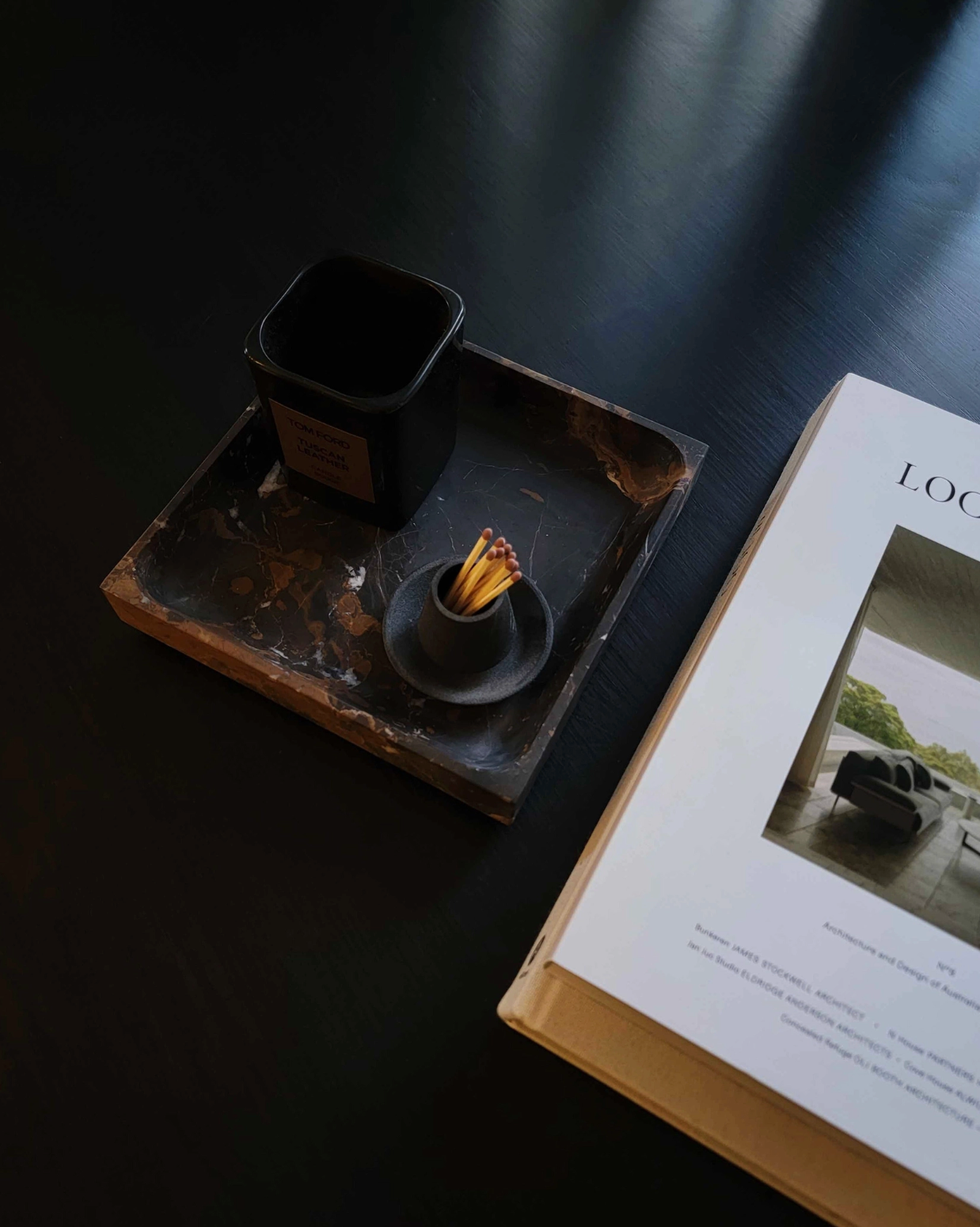
The Azóia Marble Tray placed on a dark desk communicates something specific: a surface organised around a material decision. The same tray on a pale surface creates different contrast, a different story. Neither is wrong. Both are deliberate.
Before placing anything, I ask: what does this surface do in the morning? What does it do at 6pm? Objects that earn their place do so across the whole day — not just in the photograph taken at the ideal moment.
The three-heights rule applies to every shelf and console. Something tall, something mid-height, something flat and horizontal. Remove one and the surface loses its logic. The Luxury Brass Incense Burner is the mid piece. The Charcoal Croc-Embossed Basketball is the tall piece — its spherical form creates a pause that a square object cannot. The Azóia Tray is the flat base. Three pieces. One surface that makes sense.
PRINCIPLE TWO - PAIRING
Nothing should be styled alone. Objects in conversation create meaning that isolated objects never can.
The Luxury Aged Brass Tealight Holder lit on the Azóia Marble Tray: warm aged brass on cool dark marble. Two materials from different ends of the temperature spectrum, placed in proximity. The warmth of the brass deepens against the dark stone. The stone's gold veining echoes the metal without repeating it. This is pairing: not matching, but conversation.
The pairing principle also applies to scale. A small object beside a large one creates hierarchy — the eye knows where to land first and where to travel next. Without hierarchy, a surface is simply a collection. With it, it becomes a composition.
PRINCIPLE THREE - MOMENT
Every object has a time of day when it comes most alive. Styling for the room in general misses this. Styling for the specific moment you want is what makes a home feel considered.
The Long Oversized Lighter in Shagreen & Brass on a desk at 9am is a sculptural object. At 7pm, when it is picked up and used, it becomes something active — the moment of lighting something becoming part of the room's ritual. These are two different objects in one form.
The Luxury Aged Brass Tealight Holder demonstrates the Moment principle most precisely. Unlit, it is geometric and still. Lit, the concentric rings hold a flame at their centre and the whole object changes character. Style it where the evening light will find it first.

PRINCIPLE FOUR - CONTRAST
Beauty lives at the edge between materials. A room composed of one material world — however carefully chosen — is monotonous. A room with deliberate material contrast is alive.
The Charcoal Croc-Embossed Basketball embossed composite leather beside the smooth cold surface of the Azóia Marble Tray: texture against polish. The croc pattern on the ball creates visual complexity that the marble's clean surface amplifies rather than competes with. Each makes the other more interesting.
Contrast is also about temperature: warm materials beside cool ones, rough beside smooth, matte beside reflective. The Long Oversized Lighter in shagreen — a rough, organic texture — beside the polished brass of the Incense Burner. These two objects have no business being on the same surface, which is exactly why they belong there.

PRINCIPLE FIVE - STORYTELLING
The final principle is the one that separates a considered home from a styled one. Objects with stories make rooms with depth.
The Luxury Aged Brass Tealight Holder was sand-cast by Croatian artisans using heritage techniques — sand-casting, hand-finishing, natural oxidation. That process is not visible in the finished object. But it is present in the weight of it, the texture of the aged surface, the quality of the patina. People who hold it sense that something more than manufacture went into its making.
The Storytelling principle does not require the owner to explain their objects. It requires the objects to be the kind that invite the question. When someone picks up the Charcoal Basketball from the shelf, they ask about it. When the Azóia Tray catches the light and someone notices the golden veining, they ask about it. The story comes out naturally — which is the only way a story should ever come out.
Every object in a Narrated Home edit has a story worth telling. That is the first and last criterion for inclusion.
HOW THE FIVE PRINCIPLES WORK TOGETHER
Applied individually, each principle improves a room. Applied together, they transform it.
The Placement principle tells you where to put each piece. The Pairing principle tells you what to put beside it. The Moment principle tells you which light to style it for. The Contrast principle tells you which materials to introduce for tension. The Storytelling principle tells you whether the object has earned its place at all.
Use them in order, or use them all at once. The result is a surface — a room, a home — that feels considered without being decorated.
'EXPLORE THE CURRENT EDIT'


Comments