

The Artisan Behind the Object: The Sine Handcrafted Bowl | Narrated Home
I noticed the Sine Bowl before I understood it.
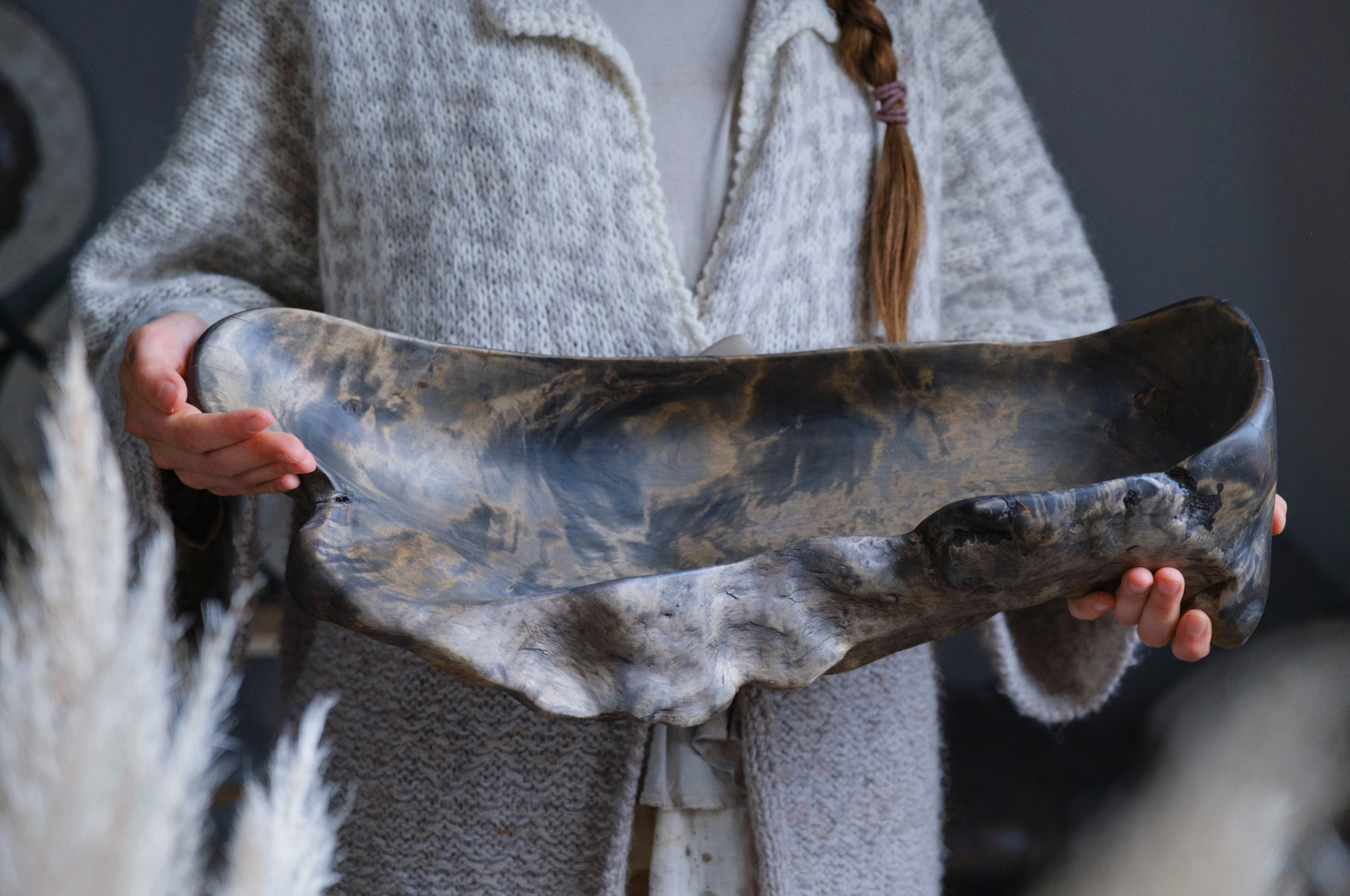
That is the best way I know to describe what happened. There was an immediate recognition — not of what it was, but of what had gone into it. The depth of the surface. The way the ebonised grain moved across the birch in a way that no two pieces could replicate.
Only after that did I learn the story. And the story made the object more of what it already was.

THE MAKERS — A HUSBAND-AND-WIFE ATELIER IN LATVIA

The Sine Handcrafted Bowl is made by a husband-and-wife team working in Latvia — a country whose relationship with forests and wood is ancient, practised, and deeply felt.
They do not source wood for the purpose of making bowls. They source wood that has already fallen — birch trees and roots that the forest no longer needs, responsibly collected and given a second life through craft rather than cut for the purpose of manufacture. This is not a marketing claim about sustainability. It is a description of how they see their material: as something borrowed from a process that was already underway, not interrupted.
Each piece begins with the tree as it arrived. The shape of the bowl emerges from the shape of the trunk or root — which is why no two Sine bowls are identical. The maker does not impose a form. They find the form that was already there.

THE PROCESS — EBONISING, SHAPING, WAXING
The surface of the Sine Bowl is the result of an ancient ebonising technique — a method that uses iron-rich water or solution to react with the tannins in the wood, darkening the grain to a deep, smoky tone without the use of paint or artificial stain.
The result is a surface that is not uniformly dark, but variably so — lighter where the grain is closer together, deeper where it opens. The bowl's interior and exterior read differently depending on the angle and the light. In morning light it is cool and almost architectural. In the long evening light of a July day, it becomes warm, rich, almost amber in places.
After shaping, each bowl is waxed three times with a certified food-safe polish. This is not decorative. It is protective — and it is what makes the Sine Bowl usable as well as displayable. A fruit bowl, a serving piece, a centrepiece that happens to be functional. The craftsmanship does not end at the visual.

WHY IT EARNED ITS PLACE IN THE NH EDIT
Every piece in the Narrated Home edit passes the same three tests: does it have a story? Does it earn its place in a room? Is it made to last?
The Sine Bowl passed all three, but the third most emphatically. At 53 centimetres long and 2.25 kilograms of solid ebonised birch, this is not a piece that ages or dates. It will look exactly as it does today in ten years, twenty, fifty. The ebonising deepens slightly over time. The wax develops a patina from handling. The bowl becomes more itself with use, not less.
At £600 it is the most significant investment in the current NH collection. I chose it because it is also the most significant object. An object that will anchor a room, start conversations, and outlast every trend that arrives around it.
HOW TO PLACE THE SINE BOWL
The Placement principle: this piece wants to be somewhere it can be seen from more than one angle.
A coffee table is the strongest position. The bowl sits low, which means the surface above it is clear for the eye to rest on after it has travelled across the ebonised grain. The organic form reads differently from across the room than it does close up — from a distance it is a shape, from near it is a material story.
A summer dining table: place the Sine Bowl at the centre, empty, as the table's anchor piece. The organic form beside the geometric precision of the Aztec Ginger Jar — dark ebonised birch beside deep blue and white porcelain — is the Contrast principle at its most complete.
A low shelf or console: the bowl's length (53 centimetres) makes it a natural horizontal anchor — the flat, low element that most shelves are missing and that every surface needs to feel considered rather than merely arranged.

WHAT THE OBJECT COMMUNICATES
When a guest picks up the Sine Bowl — and they always pick it up, because the form invites it — they are holding a piece of a Latvian forest that was going to be left there.
They are holding the hours a husband and wife spent finding the form inside that fallen wood.
They are holding a technique that is older than the brand it now represents.
That is what the Storytelling principle looks like in practice. Not a label, not a hang tag, not a paragraph on a website. An object that communicates its history through the experience of holding it. An object that makes the room feel like the person who chose it knows something worth knowing.
This is why I chose it. And this is why it will always earn its place.
See the Sine Handcrafted Bowl


Comments