
How to Style a Summer Table: Considered Hosting Without Trying Too Hard
The best tables look effortless.
They don't start that way. They start with someone thinking about the objects before they think about the occasion. Not what matches the season, not what photographs well — what earns its place at this specific table, on this specific evening, for the people who will sit around it.
This is the difference between a styled table and a considered one. The styled table announces itself. The considered table makes the room feel like someone who cares about beauty lives in it.
Here is how I build a summer table — and the objects I keep returning to.

START WITH ONE ANCHOR PIECE
Every considered table has an anchor — one object large enough to hold the surface's attention without demanding it from every other object on it.
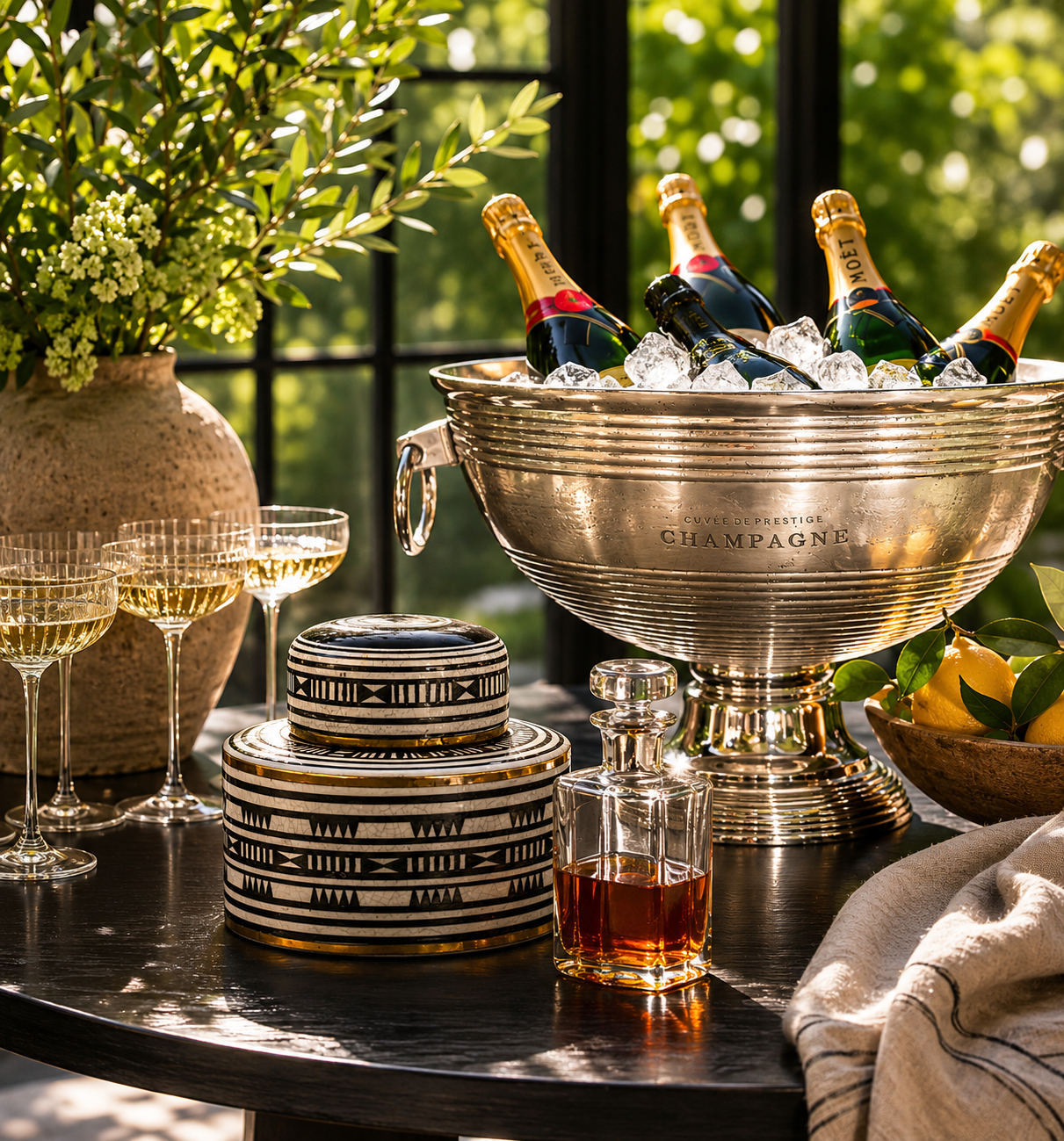
In July, the Cuvée de Prestige Champagne Bucket does this better than almost anything I've placed on a summer table. Cast from solid aluminium by artisans in India using traditional sand-casting methods, it is substantial in the way that well-made objects are substantial — not heavy to look at, but grounded. The fluted detailing and the engraved inscription belong to the language of celebration. The generous proportions hold multiple bottles, which makes it functional in a way that also happens to look exactly right.
Place it slightly off-centre. Never in the middle of the table, where it creates a barrier between guests. Off to one side, where it becomes a presence rather than an obstacle.

ADD THE DECANTING MOMENT
A table that involves the act of pouring is a table that involves the people at it.
The Flask Decanter brings that moment to a summer table with a particular kind of grace. Mouth-blown by master glass artisans in Poland, inspired by the silhouette of a vintage hip flask, its hand-painted platinum neck catches evening light in a way that clear glass without that detail cannot. The hand-ground stopper is precise — the kind of tactile detail that only reveals itself when you pick it up.
Fill it with a fine spirit. Place it at the far end of the table from the champagne bucket — two objects that belong to the same evening but occupy different positions within it. The eye travels between them and the table has rhythm.
At £90 for the medium, it is also the most accessible piece on a summer table that reads as genuinely luxurious.

INTRODUCE THE MIXING RITUAL
If the champagne bucket and the decanter establish what will be drunk, the London Cocktail Shaker Set makes the act of preparation part of the evening's theatre.
Five pieces in polished stainless steel — shaker, jigger, strainer, stirrer, muddler — hand-polished by artisans in India. The set has the kind of quiet confidence that comes from objects made without compromise: balanced in the hand, precise in function, elegant in display.
The hosting principle here is that mixing should be visible, not hidden in a kitchen. A cocktail shaker set on a bar cart or a side table near the dining area turns the preparation of a drink into a shared moment. It invites conversation before anyone has sat down.

THE VASE OR JAR THAT COMPLETES THE SCENE
The Aztec Medium Ginger Jar is the piece on a summer table that most rewards being looked at across an evening.
Hand-thrown from porcelain with a hand-etched Aztec-inspired geometric motif in deep blue and white, finished with a polished brass trim. 18 centimetres in diameter, 13 centimetres tall — the Placement principle's mid-height object. Tall enough to read across a table, compact enough not to obstruct sightlines or conversation.
The deep blue of the motif behaves differently in different lights. At midday it is bold and graphic. By candlelight — or in the long summer evening light of 9pm in July — it becomes something warmer, the brass trim catching what the day has left.
Place it behind or beside the champagne bucket. The aluminium and the porcelain create a material contrast that neither object produces alone.

THE ONE PIECE THAT ISN'T ON THE TABLE
The Sunshine Throw with Carry Strap does not belong on the table. It belongs on the chair beside the table.
Woven from cotton and recycled fibres, reversible — one side bold ochre geometrics, the other muted blue and olive — with a 200 centimetre carry strap finished in antique brass hardware. It is generous in size, 170×200 centimetres, and it drapes in the way that well-made textiles drape: with weight and intention.
On a summer evening, when the temperature drops after 9pm and someone reaches for it, it becomes the most considered object at the gathering. Not because it was designed for a table, but because it was placed there for the people who would eventually need it. That anticipation — the object placed before the moment it serves — is the Storytelling principle applied to hosting.
THE RULE BEHIND A CONSIDERED SUMMER TABLE
Three objects on a surface. Three heights. Three materials in conversation.
The champagne bucket as the tall anchor. The ginger jar as the mid piece. The decanter as the horizontal element — lower, more contained, catching light differently. The cocktail set on a side table nearby, keeping the ritual visible.
The Sunshine Throw draped on the chair, ready for when the evening earns it.
None of this is decoration. It is a decision about the kind of evening you want to have — made in advance, through objects, so that when the guests arrive, the room is already doing the work.
'SHOP THE SUMMER HOSTING EDIT'


Comentarios